O STP (Spanning-Tree Protocol) roda em bridges e switches trocando informações através das BPDUs (Bridge Protocol Data Units). Estas BPDUs contêm mensagens de configuração e incluem o ID de cada bridge e são enviadas via frame multicast.
Para operação do STP é eleito uma Root Bridge (switch-raiz). Este switch-raiz torna-se o foco da rede, sendo que as escolhas de porta-raiz, porta-designada e não-designada e todas atualizações da rede são vistas pela perspectiva do switch-raiz. Para elegê-lo os seguintes parâmetros são utilizados:
1. Menor priority value (default é 32768);
2. Menor MAC Address (0000.aaaa.bbbb.cccc.dddd.eeee é menor que 0000.aaab.bbbb.cccc.dddd.eeee).
As portas podem ter os seguintes papeis:
| Papel | Descrição |
| Root port | porta de um switch que possui menor custo ao root bridge. Sempre estão no estado forwarding). |
| Designated port | porta de um switch que mantêm conectividade. Quando há redundância de conexões, a porta com maior largura de banda é a escolhida. Se as larguras de banda forem iguais, a porta com menor número será a escolhida(ex. e1 escolhida ao invés de e8). |
| Non-designated port | porta que está em estado blocking. Quando uma porta designada perde a conectividade esta porta assume, até que receba atualização para voltar ao estado blocking |
A figura abaixo apresenta uma topologia contendo os termos abordados acima:
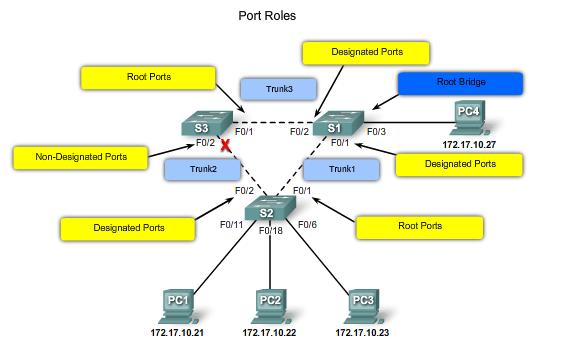
Foram visto os papéis que as portas possuem. Agora, serão vistos os estados em que elas podem se encontrar. Tipicamente, switches estão no estado blocking ou forwarding. Abaixo, é apresentado cada um dos estados, na seqüência em que eles ocorrem.
| Estado | Descrição |
| Blocking | Não encaminha frames. Recebe e analisa BPDUs. Ao ligar um switch, ele encontra-se no estado blocking. |
| Listening | Não encaminha frames, mas recebe e analisa BPDUs para se certificar que não ocorrerão loops na rede. |
| Learning | Não encaminha frames, recebe e analisa BPDUs e registra os endereços MAC dos dispositivos diretamente conectados. |
| Forwarding | Envia e recebe frames e tudo mais. Uma porta neste estado é tida como tendo o menor custo ao switch-raiz. |
Abaixo, é apresentado os timers das BPDUs:

Abaixo, é apresentado uma animação Flash muito didática que apresenta todo o processo de aprendizagem do Spanning-Tree. A MUST.
Abaixo, seguem os links de referência que foram utilizados para a produção do resumo.
Um interessante, que aprofunda o assunto é a terceira referência. Pode ser encontrada traduzida (pelo google) aqui.
Um abração,
Maurício.
Referências:
– Filippeti, M. – “CCNA 4.1 – Guia Completo de Estudo”, Visual Books/2008.
– Cisco NetAcademy, Academy Connection. “Material oficial Cisco de Estudo”. <http://cisco.netacad.net>. Acesso em: 03/03/2008.
– Cisco Systems inc. “Understanding and Configuring Spanning Tree Protocol (STP) on Catalyst Switches”.<http://www.cisco.com/en/US/tech/tk389/tk621/technologies_configuration_example09186a008009467c.shtml>. Acesso em: 03/03/2008.
The STP (spanning-Tree Protocol) runs on bridges and switches exchange information through the BPDUs (Bridge Protocol Data Units). These BPDUs contain configuration messages and include the ID of each bridge and are sent via broadcast frames.
For operation of an STP Root Bridge is elected (the root switch). This switch-root becomes the focus of the network, and the choices of the root port, port-designated and non-designated network and all updates are seen by the prospect of the root switch. To elect him the following parameters are used:
1st Lower priority value (default is 32768);
2nd Minor MAC Address (0000.aaaa.bbbb.cccc.dddd.eeee is less than 0000.aaa b. Bbbb.cccc.dddd.eeee).
The doors may have the following roles:
| Role | Description |
| Root port | port on a switch that has lower cost to root bridge. Where are the forwarding state). |
| Designated port | port on a switch to maintain connectivity. When there are redundant connections, the port with higher bandwidth is chosen. If the band widths are the same, the port with the lowest number will be chosen (eg e1 chosen instead of E8). |
| Non-designated port | port that is in blocking state. When a designated port loses connectivity to this port is, until it receives back to update the state blocking |
The figure below shows a topology with the terms discussed above:
Roles of the ports spanning-Tree.
Have seen the papers that have doors. Now, will see the states where they can find. Typically, the switches are blocking orforwarding state. Below is presented each of the states in the sequence in which they occur.
| State | Description |
| Blocking | Do not forward frames. Receives and analyzes BPDUs. By connecting a switch, it is in blocking state. |
| Listening | Do not forward frames, but receives and analyzes BPDUs to make sure that no loops occur on the network. |
| Learning | Do not forward frames, and receives BPDUs analyzes and records the MAC addresses of devices connected directly. |
| Forwarding | Sends and receives frames and everything. A port in this state is regarded as having the lowest cost to the root switch. |
Below is presented the timers of BPDUs:
Timers for each type of BPDU STP (spanning-Tree Protocol).
Below is a flash animation that presents very intuitive the process of learning the spanning-Tree. A MUST.
Below, follow the links to reference that were used to produce the summary.
An interesting, which deepens the matter is the third reference. Can be found translated (by Google) here.
A Abrasive,
Maurício.
References:
– Filippeti, M. – “CCNA 4.1 – Complete Study Guide, Visual Books/2008.
– Cisco NetAcademy, Academy Connection. “Cisco Study Material official.” <http://cisco.netacad.net>. Acesso em: 03/03/2008.
– Cisco Systems inc. “Understanding and Configuring spanning Tree Protocol (STP) on Catalyst Switches”.<Http://www.cisco.com/en/US/tech/tk389/tk621/technologies_configuration_example09186a008009467c.shtml>. Acesso em: 03/03/2008.

Só uma correção…
“..são enviadas via frames broadcast.”
o correto seria:
“são enviadas via frames multicast.”
Oi Aderbal,
Muito bem observado!
Complementando, os BPDU multicast utilizado no STP são:
– quando a VLAN nativa é utilizado é: 0180.C200.0000
– quando é utilizado o PVSTP (per-VLAN STP) é: 0100.0CCC.CCCD
Obrigado pelo aviso.
Abraço,
Bentow.